
Serve · Pair · Keep
Tasting
& recipes
Roquefort asks for little to reveal itself. A moment, a blade, a plate. Pairings come after, chosen without emphasis, so that the cheese stays at the centre.
Serve · Pair · Keep
Roquefort asks for little to reveal itself. A moment, a blade, a plate. Pairings come after, chosen without emphasis, so that the cheese stays at the centre.
Chapter I · The table gesture
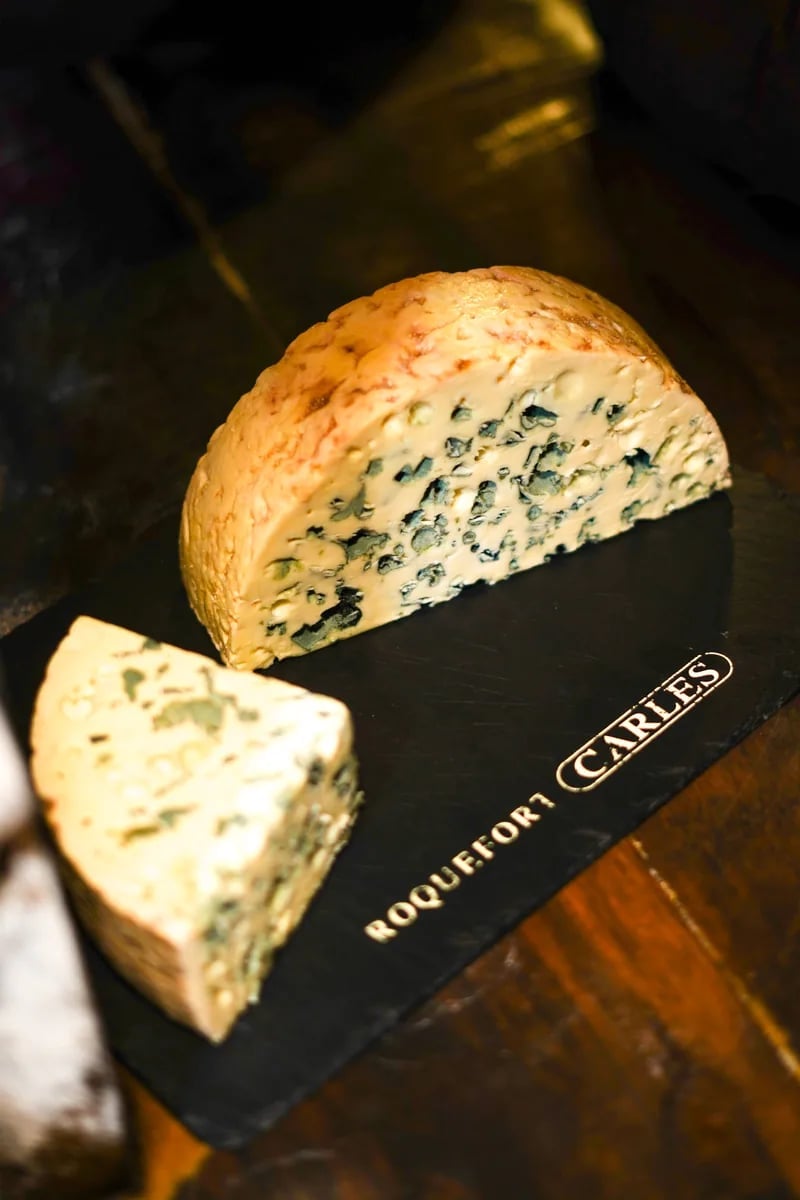
Four gestures, in order. The paste speaks for itself when it is at temperature and correctly cut. The rest calls for patience and a little attention.
Cold fixes, warmth reveals.house rule
Chapter II · The paired table
Range I · The reference
Dense paste, pronounced blue, signature of the travet. Pairings of scale to carry its length.
Wines
i.Assumed sugar, oxidation, acidity that holds: three ways not to bend before the dense blue.
Breads
ii.Dense crumbs and marked crusts. A bread that holds the slice without fading.
Dried fruits
iii.Dry grain against tender flesh, a discreet counterpoint that extends the paste.
Honeys
iv.Dark, woody honeys, slightly bitter. Avoid floral honeys, which get covered.
Range II · The gateway
Delicate blue, measured salinity, quiet length. Gentle pairings to let the softness speak.
Wines
i.Gentle sweet wines or vins doux naturels. The sugar settles without forcing.
Breads
ii.Less dense crumbs, fine crusts. Breads that accompany without taking over.
Dried fruits
iii.Sweet touches and candied fruits, which extend the softness of the paste without tipping it into dessert.
Honeys
iv.Clear, floral honeys — your choice, depending on the mood and the season.
Two readings of the same grammar. The milk, the hand, time, and what sits alongside on the slate.
Chapter III · At home
Roquefort is a living cheese. It goes on evolving after purchase, gently, provided it is well kept. Three rules are enough.
Keep between 4 and 6 °C, preferably in the crisper drawer rather than on the colder shelves of the refrigerator.
Take out thirty minutes before tasting. Put back quickly afterwards. The back-and-forth does not disturb the paste. Prolonged warmth, however, exhausts it.
Wrap in waxed or parchment paper. Avoid cling film, which suffocates the rind and makes the paste sweat.
Then place in an airtight box to isolate the aromas. Roquefort is an assertive neighbour in a refrigerator. Best to contain it.
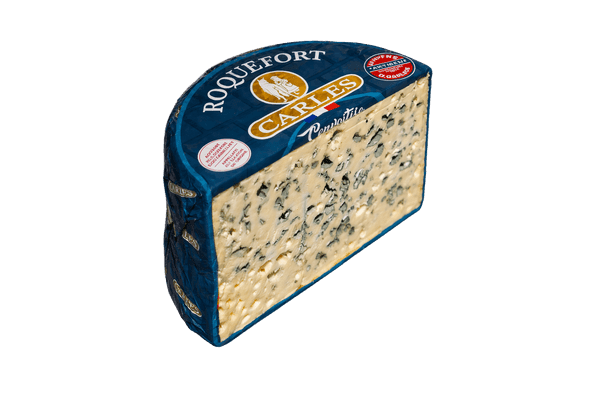
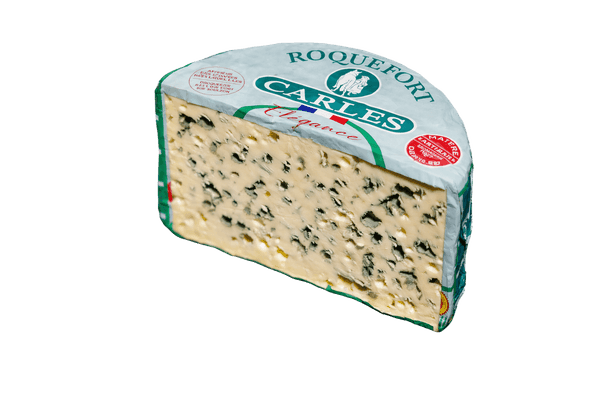
Élégance is ideally eaten within two weeks of purchase. Convoitise keeps up to three, sometimes longer if the piece is thick.
Beyond that, the cheese is not lost: it deepens. Salt becomes more prominent, the paste more pronounced. Better to buy in small quantities and renew often.
What holds for several months in industrial wrapping is no longer what the affineur handed to the customer.
Chapter IV · At the table
Leaflet I · autumn-winter
At the start of a meal
A slice of Élégance at room temperature, placed on a toasted walnut bread. Half a Comice pear and a touch of chestnut honey. To be served with a glass of Jurançon moelleux, well chilled, at the opening of an autumn meal.
Ingredients
The gestures
Suggested pairing · young Jurançon moelleux, served at 9 °C. Alternative · Muscat de Rivesaltes for a rounder profile.
Leaflet II · all year round
Main course
A creamy risotto finished with Convoitise melted off the heat, just before serving. A few sprigs of chives, a turn of the pepper mill. The dense paste carries the dish without weighing it down. To be paired with a rocket salad.
Ingredients
The gestures
Suggested pairing · Jura vin jaune served cool. Alternative · a dry white Burgundy on fine lees.
Leaflet III · winter
The chef's signature
Convoitise melted in a little whole milk, a pinch of grated nutmeg, freshly ground black pepper. To be served on a game fillet, a duck breast or simple fresh pasta. The signature of the wood comes through clearly in the heat. This is where Convoitise sets itself apart from an industrial Roquefort.
Ingredients
The gestures
Suggested pairing · a full-bodied red, Madiran or Cahors. Alternative · aged Banyuls for a sauce served on game.
§ Views · Beyond the kitchens
On the platters of chefs who know, the Carles is recognised without anyone needing to name it.
In the catalogue
Starred houses, Meilleurs Ouvriers de France cheesemongers, heritage table d'hôtes, from Aveyron to Paris and from Lyon to the Basque coast.
Paris · Lyon · Toulouse · Bordeaux · Nice
To continue
To know a Roquefort Carles, nothing replaces coming to collect it and tasting it on site.